

A Calculated Compromise: Living in the Gray
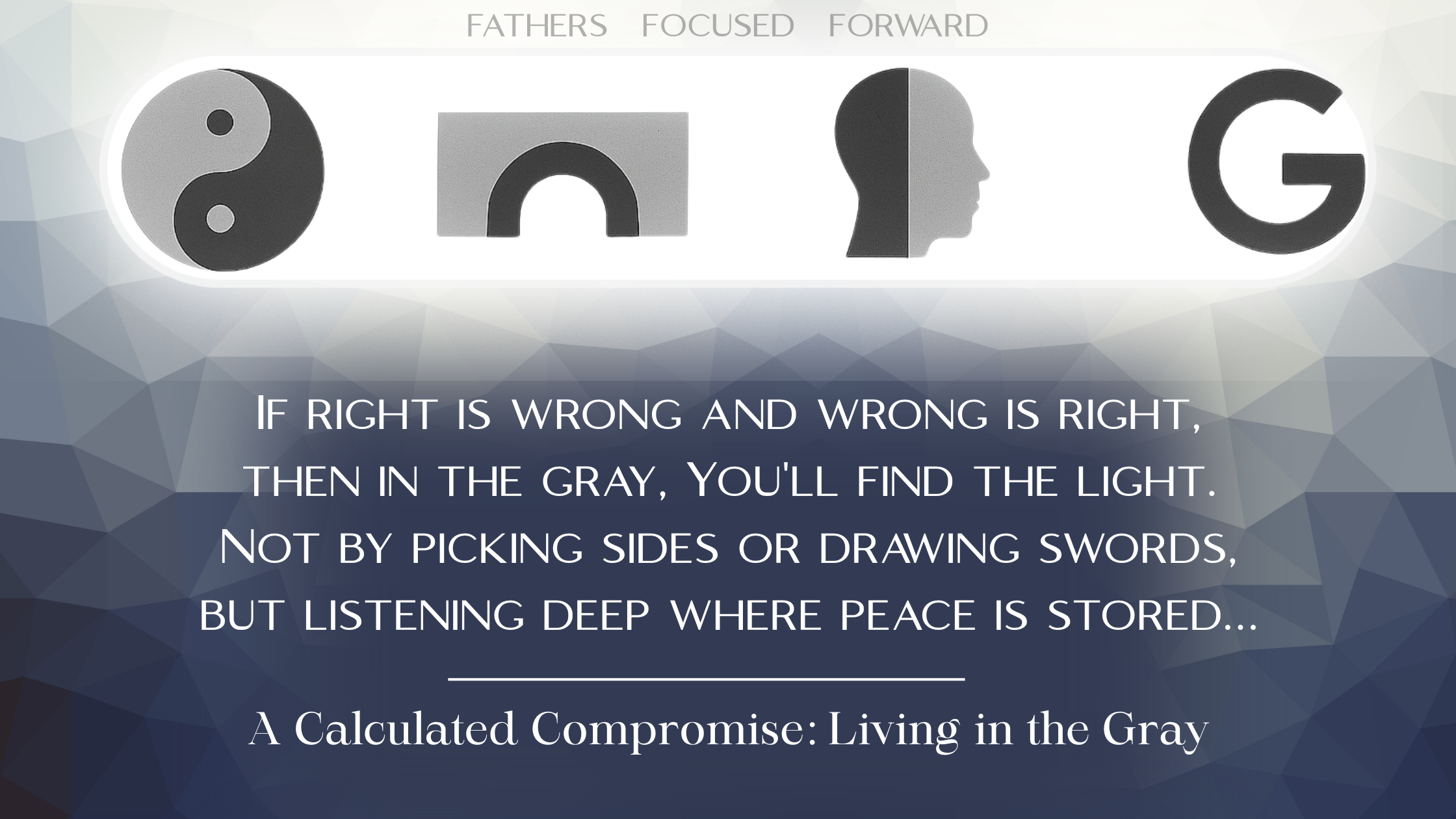
Living in the Gray
In a world where right and wrong often feel like absolutes, there lies a space not of indecision, but of intentional balance — the gray.
Black-and-white thinking can be seductive — offering the allure of certainty in a complex world. Yet beneath the surface, this binary approach often blinds us to the genuine understanding and connection that only thrive in the nuanced.
Choosing to live in the gray is not about lukewarm compromise or mirroring two sides equally. It’s a choice to refrain from unqualified judgment long enough to recognize the complex tapestry of motivations, experiences, and perspectives that shape human behavior.
It’s seeking the light of empathy through a calculated compromise: a pursuit of peace rooted in the courage to confront ambiguity, and the wisdom to accept the inherent worth of multiple truths.
Gray in Fatherhood
Parenting invites us to dwell in the gray.
Parenting, too, invites us to dwell in the gray. As we guide and grow alongside our children, we learn that no handbook can fully prepare us for the delicate balance between firm boundaries and gentle guidance.
Discipline and discovery, protection and empowerment — each has a place in the parent-child dynamic. By living in the gray, we honor the complexity of our shared journey while embracing the imperfections.
Co-Parenting in the Gray: A Calculated Compromise
In co-parenting, the temptation to make every decision a matter of fairness, consistency, or control is strong. But not every moment needs to be a battle—or even a debate.
Enter the Gray Zone. The space where neither parent has anything to gain or lose from a particular choice. The outcome isn’t “right” or “wrong”—it just is.
And in that space, there’s opportunity: to show flexibility without weakness, to build trust without negotiation, to offer grace without sacrificing your own values.
Gray Equity

Investing in the Gray
When you lean into the gray, you're not giving in—you're investing. You’re building gray equity: goodwill that strengthens the parenting relationship long-term.
It’s the “you got it this time” energy that adds up over time. It communicates: I see you. I respect your role. Let’s make this easy where we can.
A Real Example from My Life
Mila’s mom asked if I preferred she be dropped off before or after her own ride to work. Technically, I could have insisted we stick to the usual arrangement. But this was a gray moment.
The outcome—when Mila gets dropped off—didn’t affect me either way. So I chose flexibility. And so did they.
Her stepdad drops mom off at work first, then brings Mila to me. No drama. No need for control. Everyone wins. Mila’s cared for. No one’s inconvenienced. And just like that—we're cooking up co-parenting rapport without ever needing a scoreboard.
Living in the Gray Means Choosing Peace on Purpose
It’s not about surrendering—it’s about seeing the situation clearly and choosing not to fight for the sake of formality.
It’s thoughtful. It’s strategic. It’s loving. And most of all—it’s a choice that says: 'My child’s well-being matters more than my pride.'
The gray wins again.
Beyond Right or Wrong: Embracing the Gray in Culture, Politics, and Belief

We live in a world where certainty is currency. Where headlines shout in absolutes, and conversations quickly divide into “us” and “them.” But life — real, messy, relational life — rarely fits cleanly into black and white.
Whether it’s politics, religion, or societal norms, the push to choose a side can leave us disconnected, defensive, or even disillusioned. But what if there’s a better way? What if the real power is in the pause between sides — in The Gray?
The Gray is not indecision. It’s insight.
It’s where curiosity replaces condemnation.
Where empathy exists without endorsement.
Where we realize that understanding someone’s view doesn’t mean abandoning our own — it means expanding it.

The future isn’t black or white.
It’s collaborative, compassionate… and Carved in stone between the two.
Recognizing the Gray in Real Time
It’s one thing to believe in living in the gray. It’s another to catch yourself before reacting in a binary black-and-white mode. Here’s a simple approach:
Pause – When a moment triggers you, breathe before reacting.
Assess – Ask yourself: Will either choice hurt me or my co-parent?
Reflect – If neither outcome harms your child or your peace, you’ve entered the Gray Zone.
Decide with Grace – Lead with empathy and flexibility, knowing it builds trust and goodwill.
🧠Gray Matter for Thought🧠
Use these questions to check your own mindset or guide co-parenting conversations:
· Does this decision truly affect me or my child, or is it just my preference?
· Can I give my co-parent a “win” here without losing anything important?
· What choice leads to more peace and less friction?
· If my child were older, how would they view how I handled this moment?
ENTER THE GRAY…
Want support navigating parenting dynamics like this?
Charles A. Narcisse
CDC Certified Divorce Transition and Recovery Coach ®
Caring Co-Parent Coach™ and Advisory Board Member (CDC® Specialty Coach Training)
“And if no one told you today… you’re awesome!”